
Staple/Chopped Basalt Fiber
Composite Materials
- Carbon Fiber Fabrics
- Glass Fiber Fabrics
- Aramid Fiber Fabrics
- Hybrid Fabrics
- Vacuum Technology
- Carbon Fiber Tubes
- Carbon Fiber Plate
- Carbon Fiber Square Profiles
- Carbon Fiber Rod
- Carbon Fiber Rollers
- Carbon Fiber Structural Reinforcement
- Glass Fiber Tubes
- Glass Fiber Rods
- Glass Fiber Plates
- Epoxy Systems
- Adhesives
- Release Agent
- Core Materials
- Honeycomb Panels
- Roving
- FRP Reinforcement Materials
- Prepreg Systems
- Equipment
Admixtures for Construction
SHEETS CAN DOWNLOAD HERE OUR CATALOG YOU CAN
DOWNLOAD AS PDF
Staple/Chopped Basalt Fiber

 TDS Technical Document Sheet
 STAPLE BASALT FIBER
PRODUCT DATA SHEET
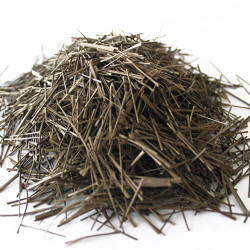
Basalt ‘chopped’ fiber is continuous filament cut to predetermined lengths to suit a particular application.
They are usually coated with a sizing/binder to make them compatible with other materials and elements with which it has to coexist the primary end product (concrete mix, for instance).
The ability of the basalt fiber to accept sizing is good. This is known as ‘wetout’.
High tensile strength
Alkali resistant
High thermal conductivity
No carcinogenic risk or other health hazards
Completely inert with no environmental risks
Resistant to acids and aggressive chemicals
High E modulus resulting in excellent specific tenacity, three times that of steel fiber
Good fatigue resistance
Electro-magnetic resistant
Typical uses for chopped fiber strands:
Basalt is the best reinforcement for concrete due to its tensile strength and natural resistance to deterioration from alkali
Reinforcement for composites, polyester/epoxy resins and plastics as used
in automotive body panels, boat hulls and pultruded products, etc.
Friction materials such as brake pads and linings
Manufacture of basalt mat/felt
High-temperature insulation applications
Passive fire protection materials
Filler for gypsum and sheetrock board requiring increased ‘burn-thru’ capability,
to meet building regulations
High-performance automotive muffler filler
Technical Data
Thermal limits of application: -260°C/-436°F to +982°C/1800°F
Vitrification temperature: 1050°C/1922°F
Melting temperature: 1450°C/2642°F
Density: 2600/2800 kg/m3
Filament diameter: 9 to 23 microns (depending on end use)
Have questions? Do you needed more information about
an product or you need a solution? Contact Us Now